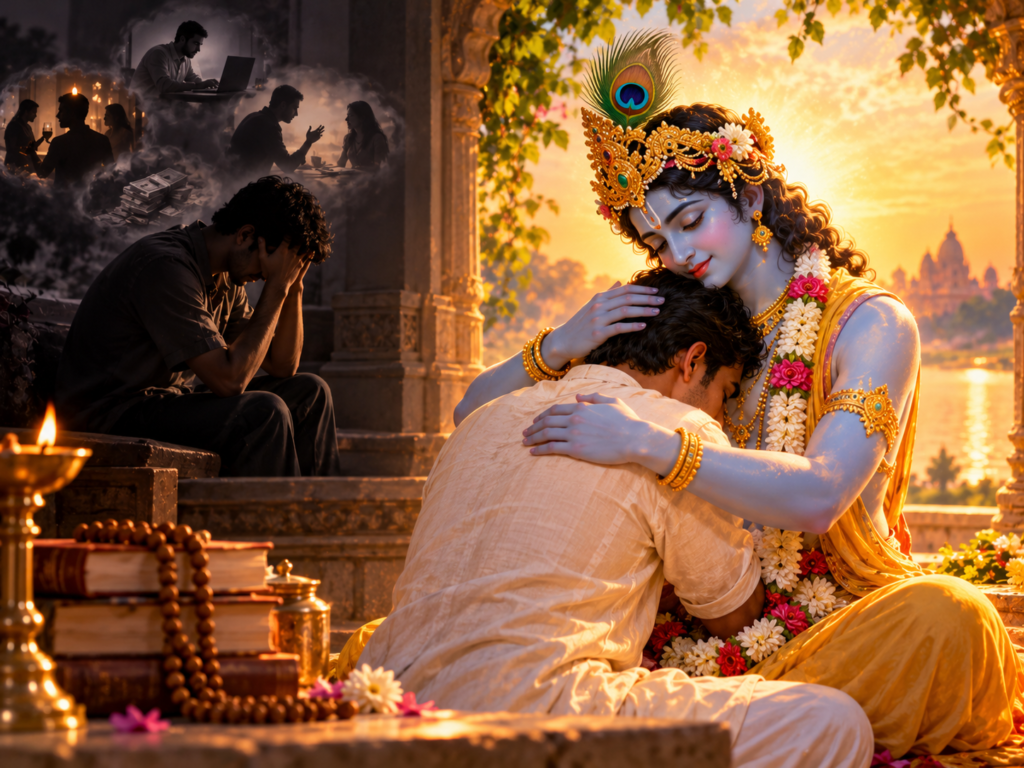
We naturally associate God with power. If God is God, He must be supremely powerful, able to control everything and everyone.
The Vedic scriptures certainly affirm this. Krishna is the Supreme Personality of Godhead, the source of everything and the controller of all that exists.
And yet the Śrīmad-Bhāgavatam presents us with a God who sometimes chooses to lose.
Krishna wrestles with His friends and allows them to defeat Him. He carries them on His shoulders. He carries the shoes of His father on His head. He becomes the chariot driver of Arjuna. And in one of the most extraordinary scenes in all of scripture, He allows His mother, Yaśodā, to chase Him, catch Him, and bind Him with ropes.
The same Supreme Lord worshipped by great sages cries before His mother when she approaches Him with a stick.
Why would the all-powerful Lord willingly accept such a subordinate position?
The answer is not that He has lost His power. He simply allows love to conquer Him.
When the Unconquerable Becomes Conquered
Our experience in this world teaches us to associate greatness with independence. The powerful person is the one whom nobody can control. The superior commands; the subordinate obeys.
So, when we think about God, we may unconsciously carry the same model with us. We imagine His greatness primarily in terms of His ability to control everyone.
But the spiritual world operates according to a different principle.
Krishna is the Supreme Lord, but He enjoys becoming a son. He is the master of everyone, but He enjoys serving His father. He is unconquerable, but He enjoys losing to His friends. He may be worshipped by everyone, but He enjoys becoming Arjuna’s chariot driver.
In Vṛndāvana, Krishna even tries to delight the elderly women by pretending to lift a heavy grinding mortar. When He cannot lift it, He slaps His arms as if to say, “I will become strong and lift it in the future.”
These pastimes may appear paradoxical from our material perspective. But they reveal something essential about Krishna’s nature.
He does not become less because He allows Himself to be controlled. Rather, He becomes more intimate.
The Śrīmad-Bhāgavatam (10.14.3) addresses Krishna as Ajita—the unconquerable Lord—and then describes how He can nevertheless be conquered:
jñāne prayāsam udapāsya namanta eva
jīvanti san-mukharitāṁ bhavadīya-vārtām
sthāne sthitāḥ śruti-gatāṁ tanu-vāṅ-manobhir
ye prāyaśo ‘jita jito ‘py asi tais tri-lokyām
“Those who, giving up the endeavor to understand You through speculative knowledge, simply hear about You from realized devotees and dedicate their lives to such hearing can conquer You, although You are otherwise unconquerable by anyone within the three worlds.”
The language is striking. Ajita becomes jita—the unconquerable becomes conquered.
And how does this happen?
Not through physical strength, intellectual brilliance, wealth, or position, but through love.
This tells us something important about bhakti. Love is not merely one quality among many that Krishna appreciates. Loving exchange is at the very heart of His pleasure.
The Love We Think We Have to Earn
If Krishna values loving relationships so deeply, what does that mean for our spiritual practice?
Perhaps our biggest misunderstanding is that we imagine we have to become worthy of Krishna’s love before we can approach Him.
We may think: I have to chant better. I have to become more pure. I have to overcome my anarthas. I have to become a better devotee..
Certainly, we should sincerely endeavor to improve ourselves. But there is a subtle danger here.
Our spiritual practices can quietly become another achievement project.
If I think, “I must perform well enough so that Krishna will love me,” then even chanting, hearing, and service can become ways of trying to earn something I imagine I do not yet possess.
We may chant because we have to become qualified. We may serve because we have to become worthy. We may hear because we have to develop a love that we believe is not yet there.
The Bhakti tradition offers a radically different understanding.
We do not have to manufacture our love for Krishna. We have forgotten it.
Śrī Caitanya Mahāprabhu explains:
nitya-siddha kṛṣṇa-prema ‘sādhya’ kabhu naya
śravaṇādi-śuddha-citte karaye udaya
“Pure love for Kṛṣṇa is eternally established in the hearts of the living entities. It is not something to be gained from another source. When the heart is purified by hearing and chanting, this love naturally awakens.”
—Śrī Caitanya-caritāmṛta, Madhya 22.107
This is one of the most reassuring understandings of spiritual life: Love is covered; it is not destroyed.
Consider what happens when we become sick. We may lose our appetite and find even our favorite food unattractive. The doctor treats the disease, but the doctor does not manufacture an appetite for us. The treatment removes the condition that was preventing our natural appetite from functioning.
Similarly, bhakti does not manufacture our love for Krishna. It uncovers it.
Our forgetfulness has interrupted our natural loving relationship with Krishna, but it has not destroyed our spiritual nature.
We can see a small reflection of this principle in our ordinary relationships. When someone dies, the body may remain, but our relationship with that body changes completely. We no longer relate to it as we did when the person was alive.
What changed?
The living being who animated that body is no longer present. The body was never the real object of our relationship. The living being within it was. And that living being is part and parcel of Krishna.
Our capacity to love, therefore, points toward our spiritual nature. Bhakti does not ask us to manufacture something foreign to who we are. It asks us to uncover what material forgetfulness has covered.
From Earning Love to Responding to Love
This understanding changes the way we approach sadhana, our spiritual practice.
Krishna Himself describes the reciprocal nature of His relationship with His devotees:
samo ’haṁ sarva-bhūteṣu na me dveṣyo ’sti na priyaḥ
ye bhajanti tu māṁ bhaktyā mayi te teṣu cāpy aham
“I am equally disposed toward all living beings; I favor no one and hate no one. But those who worship Me with devotion live in Me, and I live in them.”
—Bhagavad-gītā 9.29
If Krishna’s love is already reaching toward us, then our chanting, hearing, and service need not be attempts to convince Him to love us.
They can become our response to the love that is already there.
The external activity may look exactly the same. I still chant, hear and serve. But the relationship within the activity can be completely different. Instead of thinking, “I am doing this so that Krishna will love me,” I can think, “I am doing this because I want to turn toward Him.” Instead of, “I have to become worthy of Krishna,” I can think, “Krishna has already given Himself to me; I want to respond sincerely.”
This does not make our effort unnecessary. In fact, it gives our effort a healthier foundation.
We still need to purify ourselves. We still need to guard ourselves from distractions and anarthas. We still need to develop discipline and integrity.
But purification is no longer a payment we offer in exchange for Krishna’s affection. It is the process by which we become receptive to the affection that is already reaching toward us.
That is a very different way of approaching spiritual life.
The Day the Unlimited Was Bound
Nowhere is this mystery more beautifully revealed than in the pastime of Damodara.
Young Krishna breaks a pot of yogurt, and mother Yaśodā decides to punish Him. She tries to bind Him to a wooden mortar, but every rope she adds remains two fingers too short.
The Lord who has no limits cannot be bound by any material length of rope.
And yet, moved by Yaśodā’s sincere endeavor, He allows Himself to be bound.
The Srimad Bhagavatam (10.9.13–14) describes the scene:
“Although Lord Krishna has no exterior or interior, is Himself the beginning and end of all things, and lies beyond the reach of material vision, mother Yashoda, thinking of Him only as her own child, bound Him to the wooden mortar with a rope, as if He were an ordinary boy.”
The rope does not overpower Krishna. Love does.
And this is not a loss of His divinity. It is an expression of it.
The unlimited Lord does not need anyone, yet He desires loving relationships with His devotees. He enjoys becoming a son, a friend, or a driver. He voluntarily accepts dependence because dependence born of love is not weakness.
It is intimacy.
Perhaps this is one reason Krishna’s pastimes are so different from our material conceptions of God.
We expect the Supreme Being to remain distant because distance preserves hierarchy. Krishna does something far more astonishing. He comes close.
When Love Reaches the Root
Once we understand bhakti as a loving relationship rather than merely a system of spiritual achievement, even our understanding of purification changes.
We certainly become purified through hearing and chanting. But purification is not the final purpose. It removes what obstructs our loving exchange with Krishna.
The question gradually changes from:
“How am I doing spiritually?”
to:
“Am I turning toward Krishna?”
That shift can transform our entire practice.
And when our relationship with Krishna deepens, it does not make us indifferent to other people. It should do the opposite.
The Srimad Bhagavatam (4.31.14) gives the analogy of watering the root of a tree. When the root is nourished, the trunk, branches, twigs, and leaves are naturally nourished as well.
“As pouring water on the root of a tree energizes the trunk, branches, twigs and everything else, and as supplying food to the stomach enlivens the senses and limbs of the body, simply worshiping the Supreme Personality of Godhead through devotional service automatically satisfies the demigods, who are parts of that Supreme Personality.”
When love reaches the root, it naturally reaches the branches.
We do not love our family less because we love Krishna more. We learn to love them more purely because we understand their relationship with Him. We do not become indifferent to society. We become more genuinely concerned about its well-being. We do not merely tolerate people because scripture tells us to. We begin to see them as souls connected with the same Krishna whom we are learning to love.
The quality of our relationships changes because the center of our relationship changes.
The Love You Never Lost
Perhaps the most hopeful thing about bhakti is that we don’t have to become worthy of Krishna’s love before we can approach Him.
Krishna already loves us. We have simply forgotten that love.
Our practices of hearing, chanting and serving therefore are not meant to convince Krishna to love us. They help us remove the things that keep us from turning toward Him.
And what kind of God is waiting for us? He is Krishna who allows Himself to be bound by Yaśodā, defeated by His friends, guided by Arjuna, and served by His devotees.
Perhaps this is the greatest display of His power. Krishna can conquer everyone, yet He allows Himself to be conquered by love.
Maybe this is what we have been looking for all along. Not a love we have to earn. Not a love we have to create. We simply have to turn toward the love that was always there. The love we thought we had lost was never lost.