How do we see God? – Reflection, Recognition, Remembrance, and Reciprocation
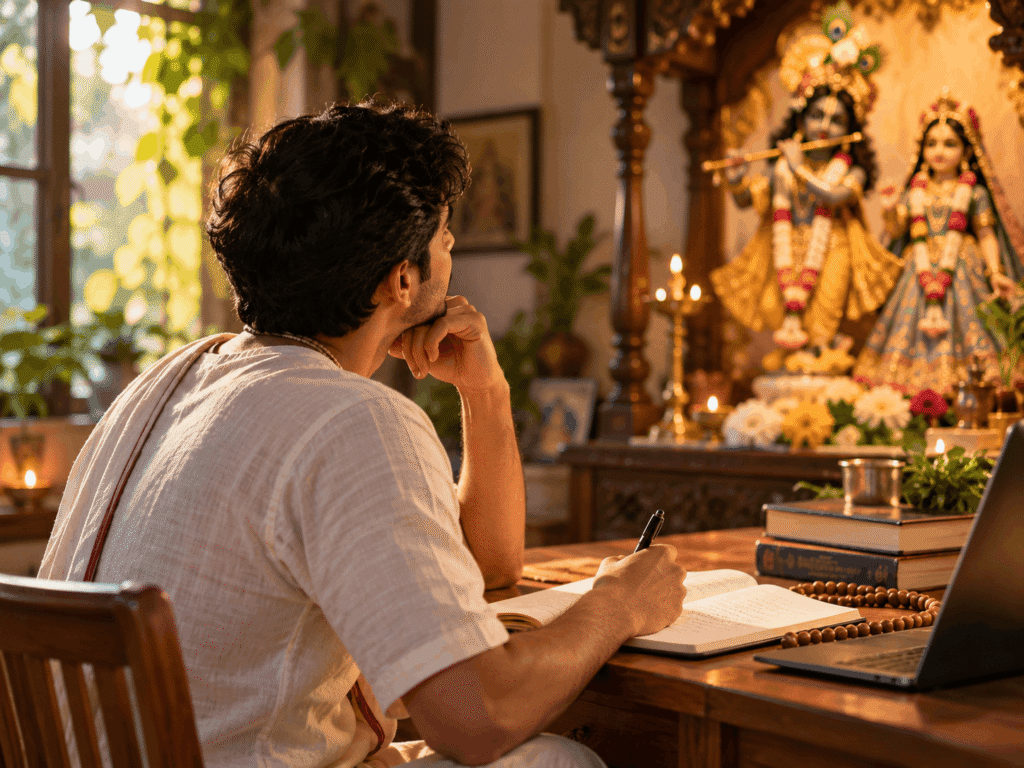
Both devotees and non-devotees see God — yet the quality of that seeing differs profoundly. The question worth asking is not whether God can be seen, but how. According to Vedic scripture and the teachings of pure devotees, a devotee sees God through four deliberate and interconnected actions: reflection, recognition, remembrance, and reciprocation. Together, these form a living, dynamic process — not a rigid sequence, but a set of practices that can be undertaken simultaneously and deepened over time.
1. Reflection: Activating the Intelligence
The first step is reflection — engaging the intelligence with the truths revealed in scripture. The Bhagavad Gita offers foundational verses for this contemplation: dehino ‘smin yathā dehe (2.13), which describes how the soul passes through boyhood, youth, and old age before taking a new body; and mātrā-sparśās tu kaunteya (2.14), which speaks of the temporary nature of pleasure and pain.
This reflection makes the devotee sober and steady. As the Gita affirms, dhīras tatra na muhyati — the wise person is not bewildered by the changes of the body, because they understand that the self is eternal. Through reflection, a devotee begins to internalise the great truth: “I do not die. The body will age and perish, and then I will receive another — but I, the soul, continue.”
Reflection is the activity of the intelligence. It is where the spiritual journey begins — not in emotion alone, but in the disciplined engagement of one’s reasoning faculty with sacred knowledge.
2. Recognition: Seeing God in the Emotional Heart
Sustained scriptural reflection leads naturally to the second step: recognition. Through reflection, the devotee begins to recognise the eternal nature of the soul — and, gradually, the presence of the Lord residing within the heart. The Gita confirms this in a beautiful verse: īśvaraḥ sarva-bhūtānāṃ hrd-deśe ‘rjuna tiṣṭhati — “The Supreme Lord dwells in the hearts of all living beings, O Arjuna” (18.61).
One might wonder: if God is in the heart, can He be detected by an X-ray machine or sonogram? We need to clarify this. There are two hearts — the biological heart that pumps blood, and the emotional heart where love, gratitude, and affection reside. It is in this emotional heart that God is to be recognised, not through instruments of the body, but through the instruments of feeling.
This recognition arises when we reflect on the gifts we have received without our own effort — the sunrise, the air we breathe, the love of family, the beauty of the natural world. In gratitude and wonder, we begin to sense the hand of something greater. The Bhakti scriptures describe this beautifully: premañjana-cchurita-bhakti-vilocanena — saintly persons see God with eyes anointed by the salve of love. As it is said, santaḥ sadāiva hrdayeṣu vilokayanti — saints always see the Lord within their hearts.
Recognition, then, is the activity of the heart. It is where love begins to stir.
3. Remembrance: Keeping Krishna in the Mind
Once the heart begins to recognise God’s presence, we naturally wish to hold onto that recognition. This is where remembrance — smaranam — enters as the activity of the mind. Krishna Himself recommends this practice in the Bhagavad Gita: yoginām api sarveṣāṃ mad-gatena ‘ntar-ātmanā — “Of all yogīs, one who always abides in Me with great faith, worshipping Me in transcendental loving service, is most intimately united with Me.”
The Srimad Bhagavatam echoes this at its very conclusion (12.13.1): great yogīs see the Lord in their hearts through deep meditation. The instruction is clear — smārtavyai satataṃ Viṣṇu, vismartvayo na jātu ca: always remember Vishnu, never forget Him.
Yet remembrance, properly understood, is more than thinking about Krishna at intervals. It includes a quality of presence — of mindfulness. Consider this: if someone claps their hands before you, in that very instant you are not remembering anything. You are simply present, hearing the sound fully, without thought. That quality of alert presence is also part of remembrance. Just as in a good conversation we both speak and listen, in our remembrance of Krishna we both offer our thoughts and rest in mindful awareness — listening, as it were, for His response.
This mindfulness pervades devotional life in practical ways: when we smell the fragrance of Tulasi offered to the Lord, when we honour prasad, when we hear a class on scripture — in all these moments, full presence is itself a form of remembering Krishna.
The greatest example of smaranam is Prahlad Maharaj. His remembrance was so deep and so integrated that it became indistinguishable from seeing. He did not merely remember Krishna and hope to see Him one day — he saw Krishna everywhere, in every moment. This is the pinnacle toward which our practice points.
4. Reciprocation: Devotional Service as Love in Action
The fourth step is the most transformative: reciprocation. As recognition deepens and remembrance fills the mind, sadhana — spiritual practice — ceases to feel like an obligation and becomes a joyful act of love. This is the crucial shift: we do not chant, hear, and serve because we are trying to earn Krishna’s love. We do these things because we already recognise His love for us, and we wish to respond.
Srila Prabhupada illustrates this with the example of Ambarish Maharaj, as described in Srimad Bhagavatam (9.4.18–20). Ambarish Maharaj engaged his mind on the lotus feet of Krishna, his words in describing Krishna’s qualities, his hands in cleaning the temple, his ears in hearing the Lord’s glories — every faculty, every action, offered in devotion. He did not perform these acts to acquire Krishna’s love. He performed them because he already loved Krishna. That love was the cause, and devotional service was its natural expression.
This is the standard of pure devotion. Most of us are not yet at that level — we are practitioners, sadhakas, doing our best to cultivate love. And that is precisely why it is called sadhana: practice. For the pure devotee, sadhana is not a means to love — it is the overflow of love already present. But we can begin to orient ourselves in that direction, by treating our practice not as a transaction but as an act of genuine affection.
Reciprocation is the activity of the body and senses — the embodied expression of all that the intelligence, heart, and mind have internalised.
What the Non-Devotee Sees
Even those who never reflect, recognise, or remember God do encounter Him — but they cannot recognise what they are seeing. Consider the story of Prahlad Maharaj and his father, Hiranyakashipu. Prahlad saw the Lord everywhere because he had cultivated recognition in his heart. When the Lord appeared, Prahlad recognised Him with love. Hiranyakashipu, however, had never undertaken any of these inner practices. And so, when the Lord appeared before him, he could only experience the encounter as death.
This is the reality for all of us who avoid these practices: Krishna will ultimately come as death, as He confirms in the Bhagavad Gita — mtyḥ sarva-haraś cāham: “I am all-devouring death” (10.34). Everything will be taken away. We cannot stop what comes — because what comes is the Lord Himself, experienced through the lens of our own unpreparedness.
This reflection — that something inevitably takes everything from us, and that we are powerless before it — is itself the beginning of seeing God. A closed mind that refuses to recognise, to reflect, or to serve will encounter God only as loss. An open mind begins to see the hand of the divine in all of life’s movements.
Liberation: Not Stillness, but Spirited Action
Some practitioners, upon experiencing the peace that comes with meditation and inner stillness, mistake that peace for liberation itself. They grow quiet, withdraw from action, and assume the journey is complete. But the scriptures paint a different picture of liberation.
The Bhagavata Purana clarifies: evaṃ prasanṇa-manaso bhagavad-bhakti-yogataḥ / bhagavat-tattva-vijjñānaṃ mukta-saṅgasya jāyate — liberation arises in one whose mind is joyful through devotional service, and who has understood the truth about the Lord. Muktir hitvānyathā rūpaṃ svarūpeṇa vyavasthitiḥ — liberation means being established in one’s original, beautiful nature of devotional service.
The liberated soul is not inactive. Think of a patient in hospital: while ill, the patient is active in the way of suffering — struggling, in pain, helpless. Upon recovery and discharge, the patient does not simply lie still. He rises, runs, and engages the world with full vitality. In the same way, without Krishna consciousness we work endlessly — birth after birth, like birds, dogs, or trees — driven by material necessity. But with the cultivation of these four practices, we can be cured and discharged into a different kind of action: liberated, loving devotional service that ends the cycle of birth and death.
Right now, we practice as a duty — with the aspiration to reach love. In the liberated state, we act from love itself. The difference is not in the actions but in the source from which they flow.
A Glimpse of the Liberated State — Here and Now
The beautiful invitation of these four practices is this: we do not have to wait until liberation to taste what liberation feels like. The Bhagavad Gita’s path of Bhakti Yoga — endorsed by Krishna Himself — is designed to give us a foretaste of that liberated state even now, in this life, in this body.
These four actions correspond to four aspects of our being. Reflection is the work of intelligence. Recognition is the work of the heart. Remembrance is the work of the mind. Reciprocation is the work of the body. When all four are engaged in Krishna’s service, we see God — not as an abstract theological proposition, but as a living reality in our own emotional hearts.
Just as Prahlad Maharaj saw the Lord not because he was extraordinary, but because he practiced being present in his Krishna consciousness — so too can we. We can begin right where we are. We can reflect, recognise, remember, and reciprocate — and in doing so, feel loved by Krishna, feel love for Krishna, and glimpse the beauty of a life no longer bound by the dream-like cycle of birth and death.
This is how we see God. And this seeing is the beginning of waking up.