A wedding party travelled all night by boat. Before setting off, the boatman assured them, “I’ll row through the night, and we’ll reach our destination by morning.” The breeze was pleasant, and everyone slept peacefully.
When they woke up at dawn, they expected to find themselves at their destination. Instead, they discovered they had not moved an inch. They were furious. When they confronted the boatman, they were even more astonished. He was drenched in sweat. He had sincerely rowed throughout the entire night.
If he had worked so hard, why had they not gone anywhere?
The answer was simple. They had rowed all night—but forgotten to lift the anchor.
Śrīla Prabhupāda used this simple story to illustrate one of the greatest dangers in spiritual life.
When Spiritual Practice Becomes an Anchor Instead of a Boat
Sometimes our spiritual life resembles that wedding party. We appear to be doing many religious activities, yet we don’t seem to be making much spiritual progress.
The Śrīmad-Bhāgavatam identifies the reason:
dharmaḥ svanuṣṭhitaḥ puṁsāṁ
viṣvaksena-kathāsu yaḥ
notpādayed yadi ratiṁ
śrama eva hi kevalam (SB 1.2.8)
“The occupational activities a person performs according to his position are simply useless labor if they do not awaken attraction for hearing the messages of the Supreme Personality of Godhead.”
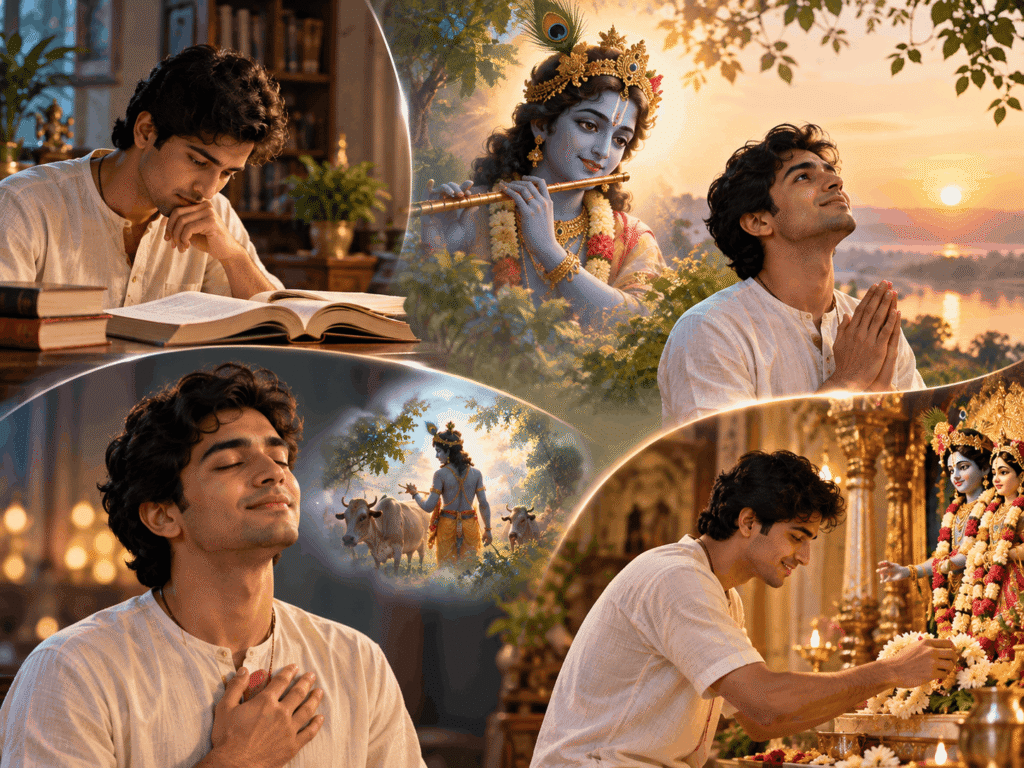
We may attend the temple, perform rituals, observe vows, chant our rounds, and study the scriptures. But if we fail to offer our heart to Krishna, and if these practices do not gradually awaken love and attraction for Him, the anchor is still in place.
Bhakti is not merely about performing the external activity; it is about investing our consciousness in that activity. The real offering is not just our hands, voice, or time—it is our heart.
That is why Śrīla Prabhupāda named the movement International Society for Krishna Consciousness. The emphasis is on ‘consciousness’. The goal is not simply to do things for Krishna but to consciously connect with Krishna while doing them. Otherwise, our devotional activities may become like rowing a boat all night without first lifting the anchor.
The Hidden Anchor
For some, self-destructive habits become the anchor that prevents genuine spiritual progress. It is like lighting the fire of Krishna consciousness through chanting and hearing the scriptures, while simultaneously pouring water on that fire through spiritually unhealthy habits and choices.
For those who have been practicing for many years, however, the anchor is often more subtle. It may no longer be obvious sinful acts but the tendency to approach God primarily as a means to improve our material life. We may deeply desire career success, good health, respect, security, freedom from anxiety, or our family’s prosperity, while externally chanting the Hare Krishna mantra and hearing Krishna’s glories.
These desires are not necessarily wrong, nor does the Bhagavatam condemn them. Krishna Himself invites people to approach Him with material needs. But if these remain the primary goal of our spiritual practice, then we are still like those passengers in the boat. We may be rowing whole heartedly, yet the anchor remains firmly in place.
While it is not wrong to approach Krishna with our needs, the boat still cannot move forward when we seek Krishna’s gifts more than Krishna Himself.
Narada’s Bold Instruction to Vyasa
In the Fifth Chapter of the First Canto of the Śrīmad-Bhāgavatam, the revered sage Nārada instructs his despondent disciple, Vyāsadeva, that even the greatest literary accomplishments are incomplete if they do not awaken attraction for Krishna. The rituals, duties, and teachings are not the problem; the purpose must remain clear—we are meant to develop a loving relationship with the Supreme Lord.
Vyāsadeva had already compiled the Vedas, the Mahābhārata, the Purāṇas, and many other scriptures. He genuinely desired the welfare of humanity, and his efforts were noble and selfless. Yet, despite all he had accomplished, he remained inwardly dissatisfied. Seeing this, his spiritual master, Nārada Muni, compassionately instructed him to compose the Śrīmad-Bhāgavatam—a scripture that directly glorifies Krishna and establishes loving devotional service to Him as the ultimate goal of life.
The same message resounds in the Bhagavad-gītā. After presenting various paths and duties, Krishna ultimately implores Arjuna to abandon all other conceptions of religion and wholeheartedly surrender unto Him (18.66). The goal of spiritual life is not merely to become religious, moral, or even knowledgeable. Its ultimate purpose is to awaken loving surrender and attraction to Krishna.
What If We Fall Down?
One reason many people hesitate to embrace the spiritual path is the fear that they may fail and be unable to continue. The process can appear overwhelming. After all, it is not easy to give up deeply rooted habits and desires for sense gratification, and instead learn to serve Krishna and offer Him our lives.
It is here that Krishna consciousness offers a refreshing message of hope. Rather than demanding instant perfection, it extends compassionate acceptance and encouragement to every serious practitioner.
In the Bhagavad-gītā (6.40–41), Krishna emphatically assures Arjuna that one who faithfully takes to this path is never a loser. Even if such a person falls short, no spiritual effort is ever wasted. Because of his committed endeavour, he continues progressing. In a future life, he takes birth in a pious family or a prosperous household and resumes his spiritual journey from where he left off.
Nārada Muni gives the same assurance to Vyāsadeva in the Śrīmad-Bhāgavatam (1.5.17):
“One who has forsaken his material occupations to engage in the devotional service of the Lord may sometimes fall down while in an immature stage, yet there is no danger of his being unsuccessful.”
For a struggling sādhaka, this understanding can be a turning point. Many devoted practitioners are not lacking enthusiasm; they are carrying the heavy burden of feeling they are never good enough. But knowing that Krishna values the direction of our life more than the perfection of our performance encourages a devotee to offer his heart to Krishna.
That is how we gradually lift the anchor.
Why There Is Never Loss
Śrīla Prabhupāda would often give an interesting example from his student days in early twentieth-century India. After six or seven rigorous years of medical study, successful candidates would be awarded the prestigious M.D. (Doctor of Medicine) degree. But even those who did not complete the full course were not left without hope. They could still qualify for the L.M.S. (Licensed in Medicine and Surgery) credential, enabling them to continue serving as medical practitioners.
The system conveyed an encouraging message: “If you succeed, wonderful. But even if you do not complete the entire course, your sincere effort is not wasted.”
Śrīla Prabhupāda used this example to explain Krishna consciousness. If we complete our spiritual journey successfully, we return to Krishna. But even if we fall short because of spiritual immaturity, Krishna does not reject us. Just as the medical student received an L.M.S. qualification instead of leaving empty-handed, Krishna ensures that no honest spiritual endeavour is ever lost. He lovingly arranges for us to continue our devotional service in a future life from where we left off.
Krishna’s Emotional Safety Net
Krishna’s reassurance creates an emotional safety net for every devotee. Knowing that no heart-felt effort is ever lost, a practitioner feels free to chant, hear, and serve Krishna without being paralyzed by anxiety, fear, confusion, or the pressure to be perfect. He knows that Krishna will take care of him. Even if he stumbles, Krishna promises that he will be given another opportunity to continue his spiritual journey. As the Bhagavad-gītā explains, such a devotee takes birth in a pious or prosperous family and resumes Krishna consciousness from where he left off in his previous life. That future birth is not a punishment but Krishna’s loving arrangement to help His devotee continue progressing.
What is remarkable is that Krishna often fulfils this promise through the culture created by pious families. In many traditional Indian homes, especially among prosperous families, there would be a temple within the house, and all family members were expected to attend the morning maṅgala-ārati. A child born into such a family would naturally grow up hearing the holy names, seeing the Deity, and participating in worship from the very beginning of life.
The same principle can be seen in many other religious traditions, where believers use their resources to naturally nurture God consciousness in future generations.
Śrīla Prabhupāda once narrated an incident from his days as a householder and pharmacist. A Muslim businessman named Abdullah regularly supplied him with glass bottles. One day, Śrīla Prabhupāda asked him, “Now that you have become wealthy, what will you do with your money?” Without hesitation, Abdullah replied, “I will build a mosque.”
Śrīla Prabhupāda appreciated this response. Rather than thinking only of his own comfort, the man wanted to use his wealth in God’s service and create a place where others—including future generations—could remember and worship the Lord.
Śrīla Prabhupāda also pointed to his own life as an example of Krishna’s arrangement. He was born into a family where the worship of Radha-Krishna was a natural part of daily life. His extended family had established a Radha-Krishna temple, which he visited regularly as a child. Growing up in such a devotional atmosphere nourished his attraction to Krishna from his earliest years and prepared him for the extraordinary service he would later render to the world.
Lift The Anchor
With this emotional cushion of Krishna’s assurance, Śrīla Prabhupāda encouraged us to lift the anchor and with full absorption enter into the process of Krishna consciousness. Krishna does not demand that we become perfect before approaching Him. Rather, He invites us to whole-heartedly practise the process, and assures us that He will guide us back to Him.
In the Bhagavad-gītā, Krishna declares:
mām upetya punar janma
duḥkhālayam aśāśvatam
nāpnuvanti mahātmānaḥ
saṁsiddhiṁ paramāṁ gatāḥ
(Bhagavad-gītā 8.15)
“After attaining Me, the great souls, who are yogīs in devotion, never return to this temporary world, which is full of miseries, because they have attained the highest perfection.”
Sincerely practising Krishna consciousness means chanting, hearing, serving, and following the principles to the best of our ability. But it also means regularly looking within and asking ourselves: “What is the anchor that is still keeping my heart tied down?” The greatest anchor is not always sinful behaviour. Sometimes it is approaching Krishna for something other than Krishna.
When we honestly examine our hearts and seek Krishna’s help, His grace descends, giving us the strength to cross the otherwise insurmountable ocean of material existence. The boat of Krishna consciousness begins to move—not simply because we increase our external activities, but because we gradually remove what is preventing our hearts from receiving Krishna’s mercy.
Therefore, the question is not only, ‘How much am I doing for Krishna?’ but also, ‘What within my heart is preventing me from receiving Krishna’s love?’