There is a well-known verse in the Bhakti tradition:
Premanjana-cchurita-bhakti-vilocanena santah sadaiva hrdayesu vilokayanti
— Brahma-samhita 5.38
The saints, whose eyes are anointed with the salve of love and devotion, behold the Lord always, within their hearts and without. The image is powerful and precise: we cannot see Krishna not because He is absent, but because our vision is obscured. It is as though we suffer from a spiritual cataract. The remedy is love — and the extraordinary news is that this love is not something foreign or unattainable. It already exists within us, lying dormant, waiting to be awakened.
Love Is Our Nature
Even at the most basic, bodily level, love is spontaneous and natural. Consider a mother dog and her puppy: without any instruction or philosophy, the mother instinctively nurtures, protects, and tends to her young. This impulse requires no cultivation — it simply arises. If such unconditional love exists even among animals, how much more natural must it be for human beings? And if love is so native to creatures bound by instinct and biology, how much more fundamental must it be to the soul, whose very origin is the Supreme Person, who is Himself the very source of all love?
Yet in our present condition, this natural love does not flow freely toward God. Instead, what seems to emerge is greed, selfishness, and a restless hunger that no worldly relationship seems able to satisfy. Why this contradiction? Why is love — which is our very nature — so difficult to direct toward the very source from whom it originates?
A Reflection of a Higher Reality
The Vedantic tradition offers a profound answer. The Vedanta-sutra opens with the aphorism:
Janmady asya yatah
— Vedanta-sutra 1.1.2
“The Absolute Truth is that from which everything is born.” The Supreme Lord is the origin of all — not merely in the physical or causal sense, but as the fountainhead of all relationships, all beauty, all love. What we experience here in the material world is not invented; it is a reflection, albeit a distorted one, of a perfect and eternal reality that exists in the spiritual realm.
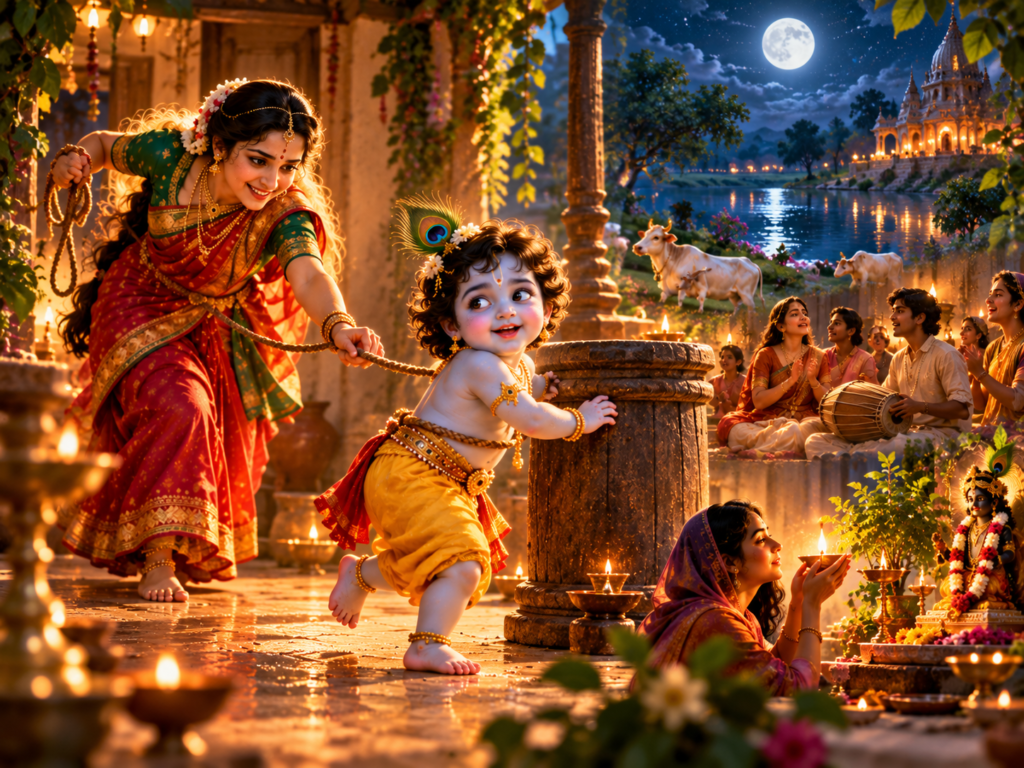
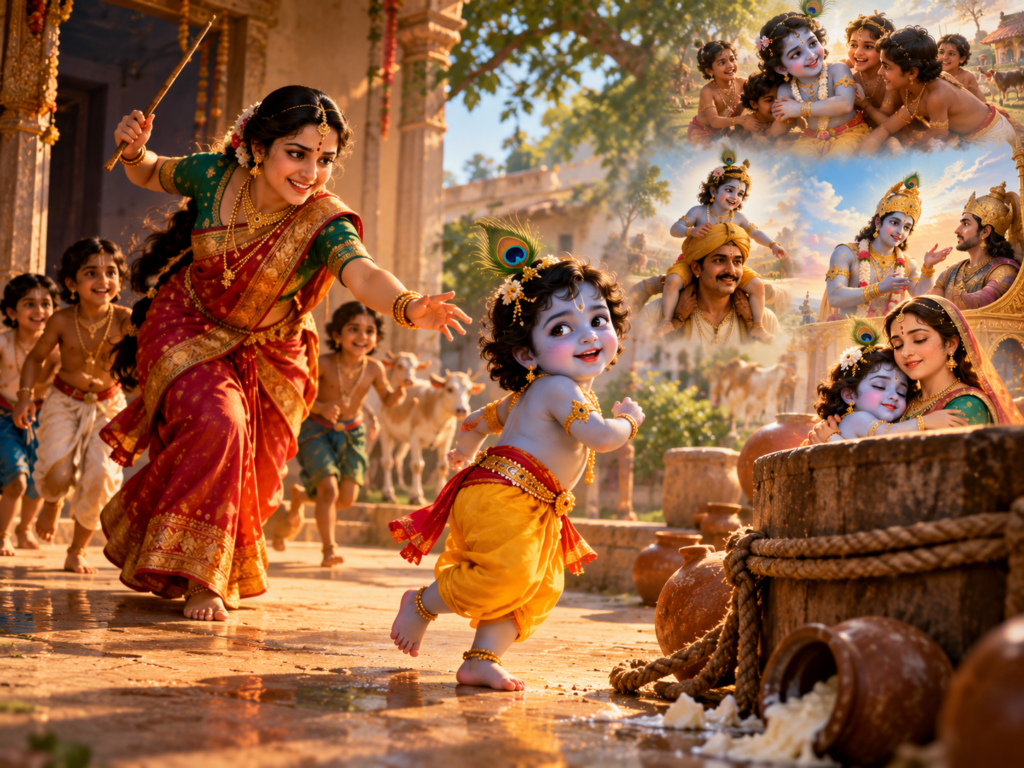
In the spiritual world, the devotee serves Krishna with pure and selfless joy — not out of compulsion or contract, but out of genuine love that never diminishes. A mother’s love for Krishna as her child (vatsalya-rasa), a friend’s love (sakhya-rasa), a servant’s love (dasya-rasa), and a lover’s love (madhurya-rasa) — all these are present there in their highest, most complete form, exemplified in the relationships of Yashoda and Krishna, the cowherd friends and Krishna, and Radharani and Krishna.
Here in the material world, these same relational impulses exist, but they are bent and refracted through the lens of selfishness and impermanence. A servant serves only as long as the wages flow; a lover’s devotion may fade when circumstances change. This is what the tradition calls maya — illusion. Not that love is false, but that the form in which it appears here is a pale and distorted shadow of its original brilliance. As Lord Krishna explains in the Bhagavad-gita:
There is an imperishable banyan tree that has its roots upward and its branches down, and whose leaves are the Vedic hymns. One who knows this tree is the knower of the Vedas.
— Bhagavad-gita 15.1
Just as the reflection of a great tree appears inverted on the surface of a river, so too the world we inhabit is an inverted image of a higher spiritual reality. When we seek love, intimacy, and belonging in this world and find them incomplete or fleeting, it is because we are reaching for the reflection rather than the tree itself.
The Longing That Points Us Home
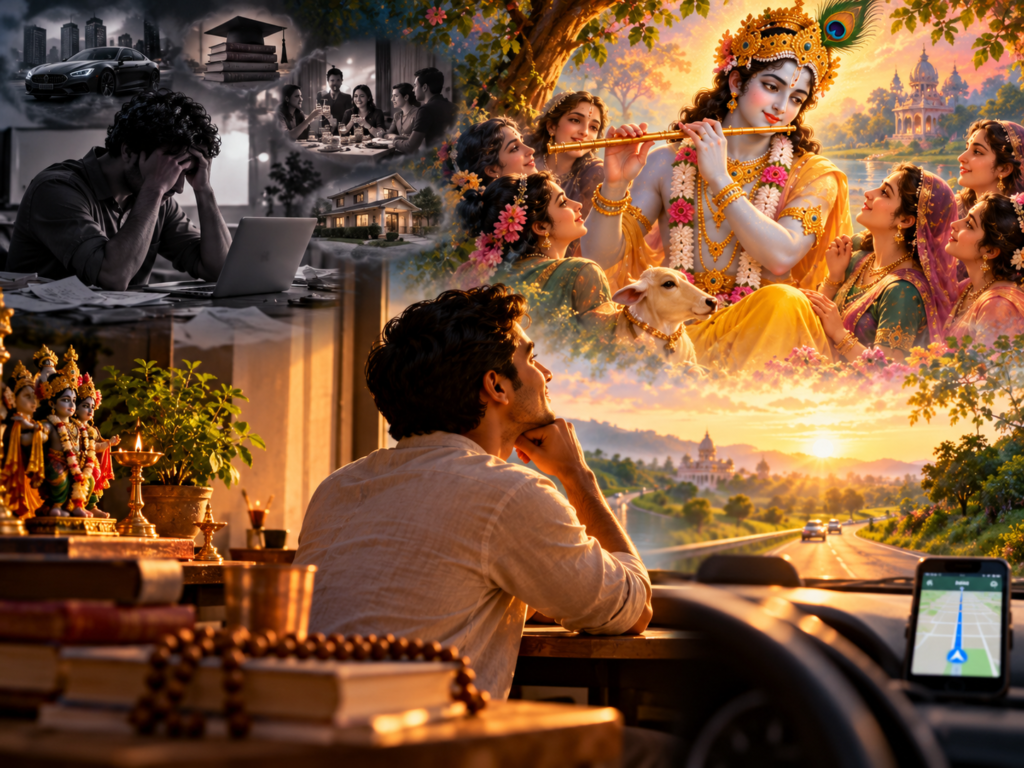
This recognition brings both consolation and direction. The very ache of incompleteness that we feel — the sense that no worldly love quite fills the space within — is itself a sign that we belong to something greater. We are not defective; we are simply reaching for love in the wrong direction.
The scriptures point us toward a relationship with God that is not imaginary or abstract, but deeply personal. The Puranas narrate that Nanda Maharaj and Yashoda devi, before Krishna’s appearance, performed years of austerity and prayer. When the Lord appeared before them and offered them a boon, they said simply: “We want a child like You.” The Lord smiled and replied: “Why like Me? I Myself will become your child.” This is the intimacy that awaits — not a cold, hierarchical relationship with an unapproachable deity, but a tender, living bond in which God Himself agrees to play every role that love requires.
How to Revive Dormant Love
So how does one begin? The tradition is clear: the process of revival begins with hearing.
Hearing (shravana) is the first and foundational step. By attentively receiving the words of scripture and the teachings of genuine devotees, we begin to form an accurate picture of the Lord — His form, His qualities, His pastimes. The Brahma-samhita (5.1) offers a glimpse of who He is:
I worship Govinda, the primeval Lord, whose transcendental form is full of bliss, truth, and substantiality — full of the most dazzling splendor. Each of the limbs of that transcendental figure possesses in Himself the full-fledged functions of all the organs, and He eternally sees, maintains and manifests the infinite universes, both spiritual and mundane.
— Brahma-samhita 5.1
This is the God we are invited to know — not a philosophical abstraction, but a living Person whose beauty, power, and love are without limit. To hear of such a Person, again and again, is the beginning of remembrance.
The second step is inquiry (jijnasa). The Vedanta-sutra itself opens with the injunction: athato brahma jijnasa — “Now, therefore, let there be inquiry into Brahman.” Human life, unlike animal life, carries the capacity for this deeper questioning. Who am I? Where have I come from? What is the source of this existence? When we trace the chain of cause and effect sincerely — my father, his father, and so on through all of creation — we are inevitably led back to the one uncaused cause, the Supreme Person.
The third step is gratitude and prayer. As we begin to understand, intellectually at first and then more personally, that God loves us and has always loved us — that He has crafted this whole extraordinary universe and placed within every heart the longing to return — we begin to respond. Gratitude and prayer are not performances; they are the natural response of a heart that has begun to truly hear.
Love Transforms Everything
When love for Krishna begins to stir — even faintly — the entire landscape of devotional life is transformed. The pastimes of Krishna, which may initially seem like mythological stories, become windows into a living reality. Krishna lifting the great Govardhan Hill effortlessly, as a seven-year-old boy, to shelter His devotees from torrential rain — a devotee who has tasted even a drop of love for Him hears this and is moved not to analyse, but to adore.
Sri Chaitanya Mahaprabhu, the great teacher of bhakti in the fifteenth and sixteenth centuries, gave us the clearest expression of this aspiration:
na dhanam na janam na sundarim kavitam va jagad-isha kamaye mama janmani janmanishvare bhavatad bhaktir ahaituki tvayi
— Chaitanya Mahaprabhu, Shikshashtaka, verse 4
“O almighty Lord, I have no desire to accumulate wealth, nor beautiful women, nor any number of followers. I desire only Your causeless devotional service, birth after birth.” This verse does not ask for liberation, or even for happiness. It asks for love — specifically, the love of service, which is itself the fullest happiness.
The Natural State of the Soul
What the tradition of bhakti reveals, ultimately, is not a new aspiration but a recovery. The soul’s natural condition is love — love offered freely to the Supreme Person, who is the source of all love. When this love is active, the soul is at rest. When it is covered — by forgetfulness, by the conditioning of material life, by the false substitutes the world offers — the soul wanders, incompletely, through the reflection of a world that can never quite satisfy.
The path back is not complicated, though it requires sincerity. We hear. We inquire. We pray. We practice gratitude. And slowly, as the cataract of conditioning begins to dissolve, the vision that was always available becomes accessible. The love that was always there, dormant within us, begins to stir. In that stirring lies the beginning of our return home.